
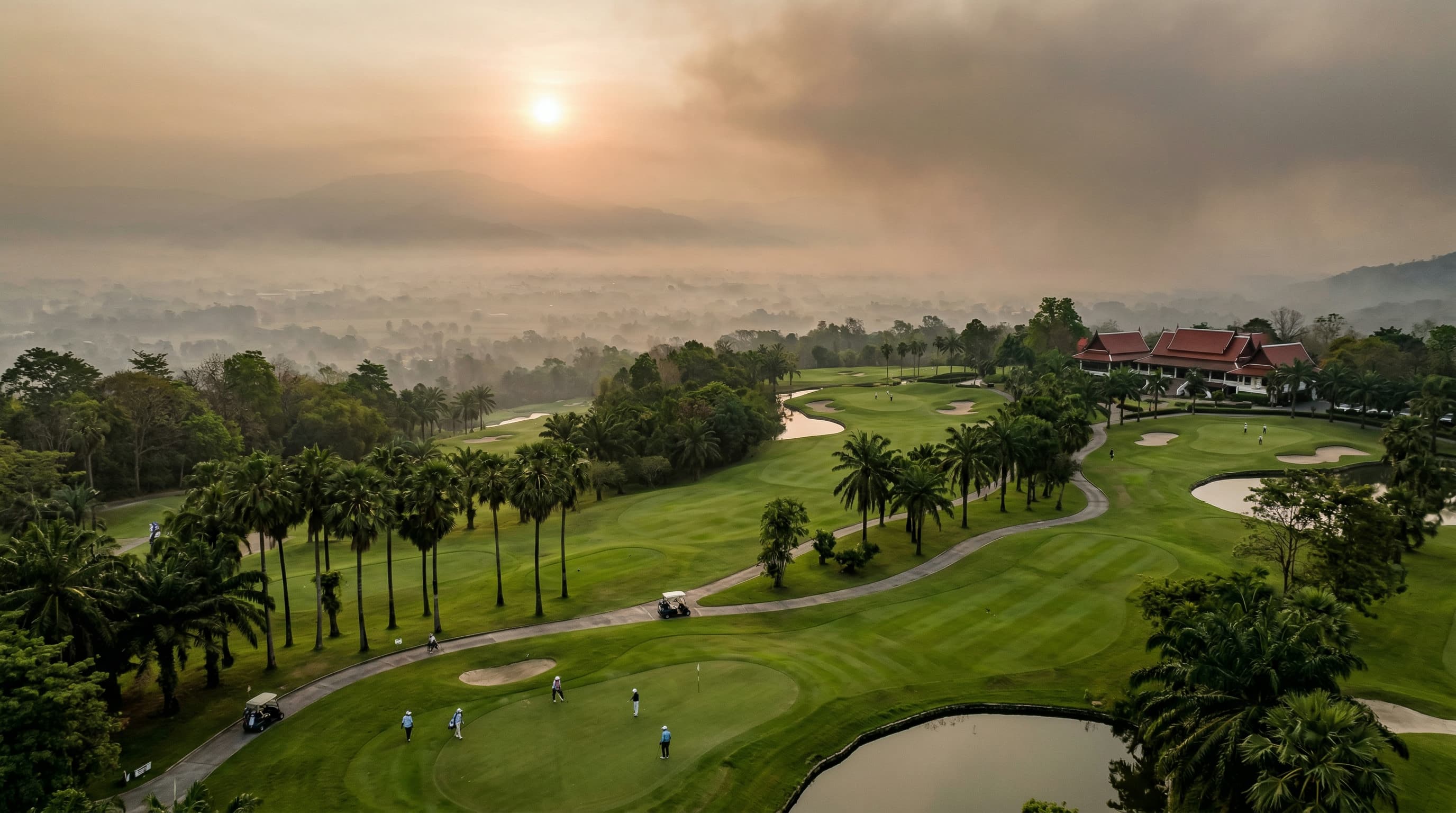
Should I Play Golf Today?
You checked the weather, booked a tee time, and now the sky looks hazy. This guide helps you read the air quality numbers and make a quick, confident decision.
The quick answer
Thailand uses the Air Quality Index (AQI) — a number from 0 to 500. Here's what it means for your round:
Clean air. No restrictions. Enjoy your round without any concerns.
Most golfers are fine. If you have asthma or lung issues, consider a shorter round or early tee time.
Reschedule or move to a coastal course. You'll breathe hard for 4+ hours — that's a lot of polluted air.
Full AQI scale
For golfers, the threshold that matters is AQI 100. Above that, you're inhaling 6–8× more pollutants than someone sitting indoors.
What's actually in the air?
The number you see is driven by PM2.5 — tiny particles smaller than 2.5 micrometers. Here's how small that is:
How small is PM2.5?
Things you'll find on a Thai golf course
Bermuda Grass
~2 mm wide
Bunker Sand
~0.09 mm
PM2.5
0.0025 mm
You can see every blade of grass on the fairway — but PM2.5 is 800× thinner. Breathing hard for 4+ hours means invisible particles go deep into your lungs.
4–5 hours outside
A full round is far longer than jogging or cycling. More time = more exposure.
Heavy breathing
Exercise increases your air intake from ~12 to ~100 liters per minute. That's 8× more pollutants per breath.
Thailand's heat
35°C+ makes you breathe even harder. Heat and pollution compound each other.
Valley courses trap haze
Many Thai courses sit in valleys or basins where pollution accumulates and lingers.
When and where it gets bad
Thailand's air quality varies dramatically by region and month. The culprit: burning season — agricultural fires across northern Thailand and neighboring countries, peaking February to April.
| Region | Jan | Feb | Mar | Apr | May | Jun | Jul | Aug | Sep | Oct | Nov | Dec |
|---|---|---|---|---|---|---|---|---|---|---|---|---|
North Chiang Mai, Chiang Rai | 150+ | 300+ | 300+ | 150+ | 80 | 30 | 25 | 25 | 25 | 30 | 80 | 120 |
Central Bangkok, Khao Yai | 110 | 120 | 80 | 70 | 40 | 25 | 20 | 20 | 25 | 30 | 75 | 100 |
South & Coast Phuket, Hua Hin, Pattaya | 30 | 35 | 35 | 30 | 25 | 20 | 20 | 20 | 20 | 25 | 25 | 30 |
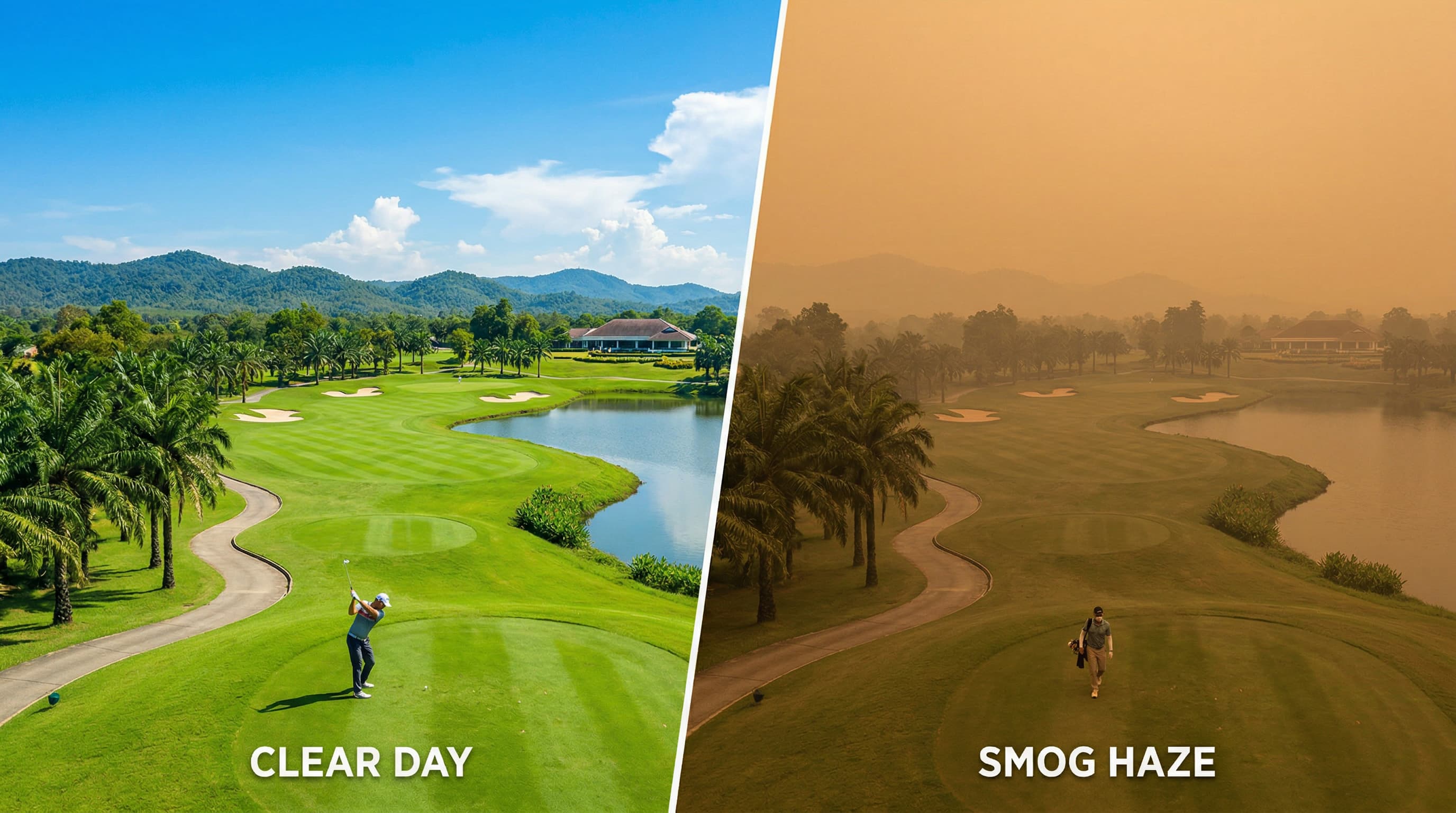
Burning season (Feb–Apr)
Agricultural fires push AQI above 300 in the north. Chiang Mai regularly becomes the world's most polluted city. If you're visiting Feb–Apr, book coastal courses instead.
Rainy season = clean air (Jun–Oct)
Monsoon rains wash the air clean nationwide. AQI stays under 50 everywhere. Brief afternoon showers are manageable with early tee times — best air quality of the year.
What you can do about it
Five practical things — ranked from most to least effective.
Check AQI before you book
Every course page on SawadeeGolf shows real-time AQI updated every 2 hours. Check it the morning of your round — conditions can change overnight.
Play early morning
AQI is typically lowest between 6–8am. Book the earliest tee time available. You'll finish before both the pollution and the heat peak.
Choose coastal courses during burning season
Sea breezes keep Hua Hin, Phuket, Pattaya, and Koh Samui clean year-round. If you're visiting Feb–Apr, head to the coast.
Hydrate more than usual
Pollution compounds dehydration. Drink 50% more water than you normally would. If you feel a scratchy throat, headache, or unusual fatigue — stop playing.
Use the cart, breathe through your nose
Ride between holes to reduce exertion. Nasal breathing filters more particles than mouth breathing. Small adjustments, meaningful difference.
Common questions
What AQI is safe for playing golf?
Does bad air actually affect my game?
Should I wear a mask while playing?
Where in Thailand has clean air year-round?
Check your course now
Real-time AQI for every golf course in Thailand. Updated every 2 hours. Free.